

Ankle Sprain Recovery: Why PEACE & LOVE is Replacing RICE
Ankle sprains are one of the most common musculoskeletal injuries seen in North Texas sports and recreational activities. For decades, the go-to advice after rolling your ankle was simple: RICE (Rest, Ice, Compression, Elevation).
But our understanding of injury recovery has evolved. Today, sports medicine professionals across the globe and at Pursuit Physical Therapy are shifting toward a newer, more comprehensive approach: PEACE & LOVE. This framework emphasizes education, early movement, and active rehabilitation rather than prolonged rest and immediately suppressing inflammation.
So why the change? Current research suggests that the body often heals better with the right kind of movement and loading, not a complete shutdown. Let’s break down how to best manage an ankle sprain for a faster, safer return to your favorite activities.
The Traditional Approach: What is the RICE Method?
The RICE method was popularized in the 1970s and became the standard first-aid recommendation for soft tissue injuries. It includes:
R — Rest
I — Ice
C — Compression
E — Elevation
The goal of RICE was primarily to reduce swelling and pain immediately after injury. While this provides short-term symptom relief, research has increasingly questioned whether it actually optimizes long-term healing. Evidence reviews (such as van den Bekerom et al., 2012) have found limited high-quality support for many components of RICE in treating ankle sprains.
The major limitation? RICE focuses almost entirely on the acute phase and fails to guide the active rehabilitation process. Tissues heal best when exposed to appropriate mechanical stress rather than prolonged immobilization.
The New Model: PEACE & LOVE
In 2019, sports physiotherapists introduced the PEACE & LOVE model in the British Journal of Sports Medicine. This framework addresses both the early injury phase and the long-term recovery continuum.
Phase 1: PEACE (Immediate Care)
In the first 1–3 days following an injury, the focus is on protection without over-immobilization:
P — Protect: Reduce stress on the injured tissue to minimize bleeding and prevent further damage.
E — Elevate: Elevate the limb above heart level to manage swelling.
A — Avoid anti-inflammatory modalities: This includes routine use of anti-inflammatory medications and excessive icing, as they can slow down the natural healing process.
C — Compress: Use elastic bandages or taping to help manage swelling.
E — Educate: Understanding your injury encourages active recovery instead of passive, outdated treatments.
Phase 2: LOVE (Rehabilitation and Recovery)
After the initial stage, your recovery should shift toward functional rehabilitation:
L — Load: Gradual loading helps stimulate tissue repair through mechanotransduction—the process where mechanical stress signals cells to rebuild stronger tissue.
O — Optimism: Psychological factors like fear and catastrophizing significantly affect outcomes. Staying positive is a clinical part of healing!
V — Vascularization: Early cardiovascular exercise (within pain tolerance) improves blood flow to the injury site.
E — Exercise: Strength, mobility, and balance exercises are essential for restoring function and preventing chronic ankle instability.
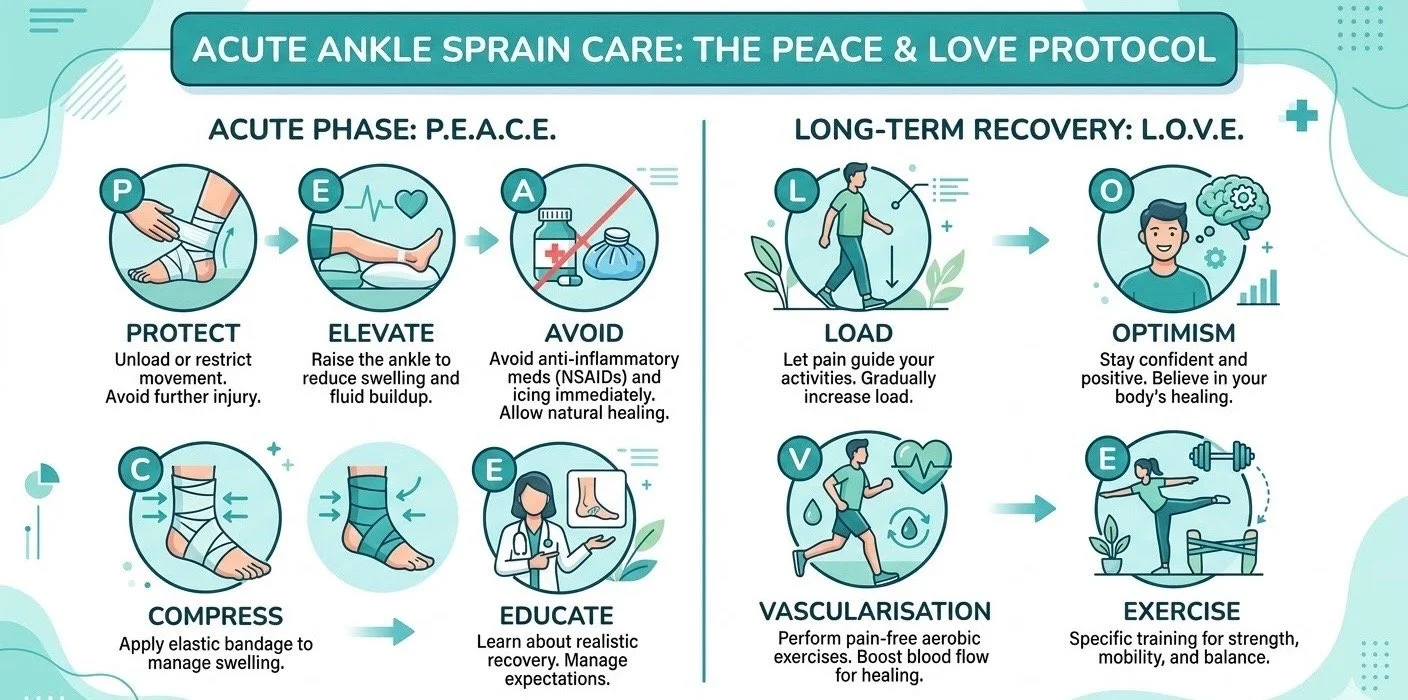
Comparison chart of RICE vs PEACE and LOVE for ankle sprain recovery.
Why Early Movement Matters for Your "Brain Map"
One of the biggest shifts in sports medicine is the emphasis on early, progressive movement. Prolonged rest can lead to muscle weakness, joint stiffness, and decreased proprioception (your body’s ability to sense its position).
Without movement, the brain can begin to “blur” the injured body part. Pain science educators like Adriaan Louw explain that the brain relies on constant input from movement and pressure. When that input stops, the "map" of the ankle in your brain becomes less clear. Gentle movement and gradual weight-bearing help "restore the map," keeping your brain connected to the joint and reducing the risk of re-injury.
When to Use Walking Boots or Seek Imaging
In some cases, short-term immobilization with a walking boot may still be appropriate. More severe ankle sprains, significant pain with weight bearing, or individuals who need to be on their feet for long periods during the day may benefit from temporary protection in a boot. The key difference with modern injury management is that immobilization is typically used strategically and for as short a time as possible. Prolonged immobilization can lead to stiffness, weakness, and delayed recovery. Even when a boot is necessary for walking, it is important to regularly remove the boot throughout the day to gently move the ankle.
A simple strategy is that we like at Pursuit is taking the boot off once every hour to perform ankle mobility exercises, such as writing the alphabet with your foot or doing slow ankle circles. Another way to improve weight bearing tolerance is taking the boot off and doing weight shifting front to back and side to side. These small, frequent movements help maintain joint mobility, improve circulation, and encourage the healing tissues to adapt to movement while still protecting the ankle during daily activity.
What if there is a fracture?
Most ankle injuries are sprains, but if a fracture is suspected, the management changes. We utilize the Ottawa Ankle Rules—a highly sensitive screening tool—to determine if an X-ray is truly necessary. This helps our North Texas patients avoid unnecessary imaging while ensuring serious injuries are identified and protected.
Why Anti-Inflammatories and Excessive Ice Are Being Reconsidered
Inflammation has long been viewed as something to suppress after injury. However, modern research suggests inflammation actually plays a critical role in tissue repair.
During the early stages of healing, inflammatory cells:
Remove damaged tissue
Release growth factors
Initiate tissue regeneration
Suppressing this process too aggressively may delay healing or impair tissue quality.
Studies examining cryotherapy and anti-inflammatory strategies show that while they may reduce pain temporarily, they do not consistently improve long-term outcomes and may interfere with healing processes such as angiogenesis and muscle regeneration.
This is why the PEACE & LOVE model recommends avoiding routine anti-inflammatory treatments in the early phase unless medically necessary.
Managing Chronic & Multiple Sprains
Think of a healing ligament like a "scab" on a knee. The new scar tissue is often less flexible and more disorganized. This leaves the joint mechanically vulnerable.
Furthermore, a sprain damages the mechanoreceptors (the sensors that tell your brain where your foot is). If you stop rehab once the pain fades, your brain’s "GPS" for that ankle remains offline. This is why one sprain so often leads to a cycle of re-injury. To break this cycle, you must continue stability and neuromuscular retraining long after the swelling disappears.
The Pursuit Point
If you or a friend sprains an ankle tomorrow, the best approach is no longer just "rest and ice." At Pursuit North Texas, we believe in a proactive approach:
Immediately after a sprain, it is important to calm initial fears, elevate the ankle, and apply gentle compression. Early, controlled movement should begin as soon as possible. Even while seated, you can do light weight shifting, ankle circles, or ABCs to keep the joint engaged. These small movements maintain mobility, stimulate healing, and help keep the brain connected to the ankle.
For athletes who sprain their ankle during sports like volleyball or soccer, the shoe and sock should usually stay on immediately after the injury to maintain stability and compression. Once safely seated, the shoe and sock can be removed to check for swelling, bruising, or signs of fracture. Using the Ottawa Ankle Rules can help guide whether an X-ray is needed to rule out a fracture. Remember, hearing a pop at the time of injury does not automatically mean a bone is broken—pops can happen in sprains too.
Once immediate concerns are addressed, gentle movement and gradual weight bearing can begin. This approach supports joint mobility, tissue healing, and proper brain mapping of the ankle, setting the stage for a faster, safer recovery.
Ready to get back on your feet? Don't let a simple sprain turn into a chronic issue.
If you're looking for expert physical therapy in North Texas and want a personalized recovery plan that goes beyond outdated protocols, book an initial evaluation or schedule a Discovery Call with our team today!
